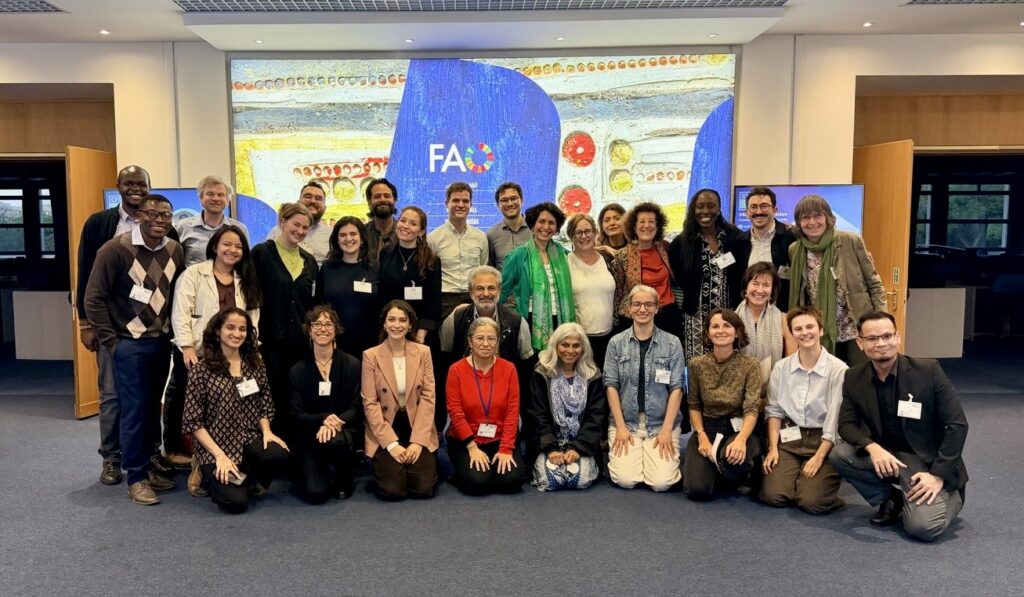
On October 22 and 23, 2026, our colleague Carolina Zuniga represented RURINNOVA at the international workshop “Human Rights and the Digitalization of Food Systems,” held at FAO headquarters in Rome alongside the 54th session of the Committee on World Food Security (CFS).
The CFS is a United Nations platform that brings together governments, civil society, international organizations, the private sector, and the research community to discuss the policies needed to ensure everyone has access to adequate food. It develops voluntary recommendations and guidelines that help countries shape their food and agricultural policies, addressing issues such as access to land, nutrition, and the sustainability of food systems. The participation of small-scale producer organizations and communities most affected by food insecurity brings their experiences and priorities into international discussions.
In this context, the workshop offered two days of discussion on how digital technologies are changing food systems and the implications for the rights of those who produce, distribute, and consume food. During the workshop, Carolina presented work developed jointly with Andrea Saba on digital agricultural advisory services. Their contribution brings together a human rights-based approach and agroecology, starting with a concrete question. When a platform recommends what to sow, whose knowledge informs that advice, and how much influence do the people farming the land have over the decision?
Looking at Digital Advisory Services Through Human Rights
A human rights-based approach begins by recognizing farmers and rural communities as rights holders. In our contribution, the right to adequate food, recognized in Article 11 of the International Covenant on Economic, Social and Cultural Rights, and the United Nations Declaration on the Rights of Peasants and Other People Working in Rural Areas (UNDROP) provide a lens for assessing the choices made by those who design, fund, or provide advisory services. This means asking who can access these services, who participates in their design, and whom users can turn to when something goes wrong.
Consider a woman farmer who shares information about her land, the varieties she grows, and her harvests over recent seasons with a digital service. For her, it matters who will be able to reuse those data and for what purposes. It also matters that she can question a recommendation that seems poorly suited to her field and receive an explanation from the service provider. Accessibility, participation, transparency, and accountability thus take on a concrete meaning. They concern the ability to use a tool on one’s own terms and retain autonomy over farm management decisions.
What Agroecology Changes
Agroecology draws attention to the relationships between soil, water, biodiversity, agricultural practices, and communities. It also brings a way of producing knowledge through dialogue between scientific research, farmers’ experience, and traditional and Indigenous knowledge. From this perspective, a crucial question for anyone designing a digital service is what the tool can recognize as a good outcome.
Let us return to the choice of what to sow. A platform might suggest the variety with the highest average yield. The person farming that land might prefer a local variety because, in drier years, it has enabled the family to harvest enough for their own consumption and save seeds for the following season. Both observations concern productivity, but they respond to different needs. If harvest reliability and the ability to reproduce seeds matter to the farmer, they must be included from the outset among the criteria the service uses to formulate its advice.
This is where agroecology and human rights meet. Farmers’ experience helps identify which choices make sense in a particular place. Participation in decision-making and control over data enable those who hold that knowledge to decide whether to share it, under what conditions, and how it should be used. An advisory service designed in this way can support an agroecological transition while respecting the priorities of the people driving it.
From Rome to Our Work with Local Communities
For RURINNOVA, the two days at FAO provided an opportunity to reconsider our work in training, advisory services, and innovation in light of these questions. One of the most useful comes before the choice of technology itself. When we sit down with farmers, advisors, and researchers, which decisions are still open?
Keeping decisions about which problems to address, what information to collect, and how to assess outcomes open gives substance to participation. This is a reflection we bring back from Rome to the places where we work. Sometimes, to understand whether a digital service will be truly useful, the first step is to ask the person farming that field why, this year too, they would choose to sow that particular variety.